
After the angel Gabriel had announced Mary's pregnancy with Jesus, Mary traveled to see her relative Elizabeth. They were presumably cousins. Mary's visit to Elizabeth is the subject of the fourth entry in our series, "The Complete Christmas Story." We told the full story of John the Baptist's birth in our second entry, but here we are backing up a bit to Elizabeth pregnant with John.
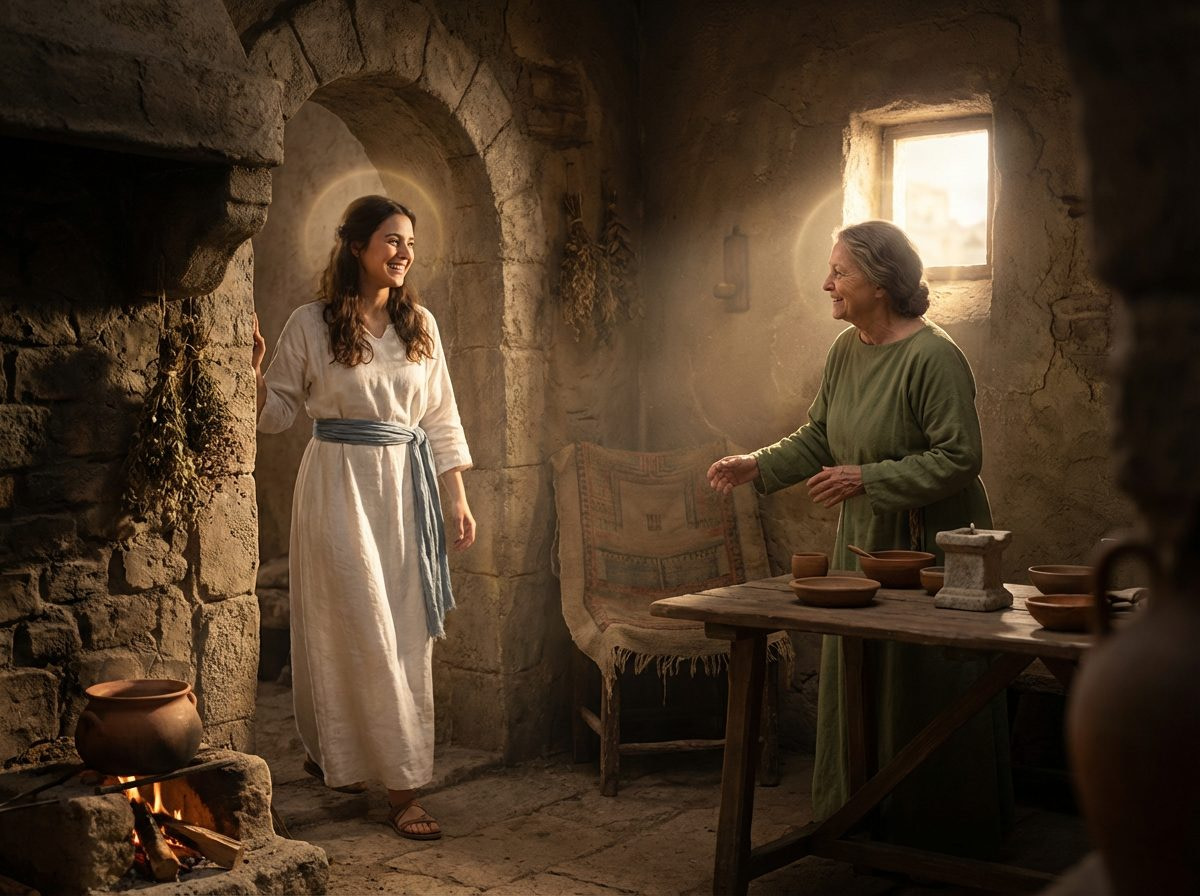
Mary's visit to Elizabeth, as told in Luke 1:39-56, is a beautiful moment that captures the essence of joy and faith. This biblical episode unfolds soon after the Annunciation, when Gabriel alerts Mary that she has been selected to bear Jesus, the Son of God. Anxious to share her miraculous news and encourage another who's also experiencing a divine moment, Mary visits her cousin, Elizabeth, who's six months pregnant with John the Baptist. While this meeting is remarkable — emphasizing the link between these two women — it also underlines the story-line for God's redemptive plan.
The Journey to Elizabeth
Mary's trek to visit Elizabeth—probably around 80-100 miles—demonstrates her willingness and enthusiasm to welcome her place in God's will. When Mary enters Elizabeth's house and greets her, something incredible happens. Elizabeth's son, John, jumps in her belly at the sound of Mary's voice. What a moment this is, with John the Baptist's unborn response to Jesus' recognition, affirming Christ's importance from the start.
Elizabeth, filled with the Holy Spirit, blesses Mary as "blessed among women" and over the child she bears. This impromptu praise is indicative of recognizing God's movement in their lives, connecting not only Jesus and John but also their mothers. Elizabeth's psalm of faith to confirm Mary's vocation and holiness, knitting them together in a potent bond.
Mary's Magnificat
In response to this moment of recognition and blessing, Mary sings the Magnificat, a rich and poetic hymn of praise. In it, she magnifies the Lord and praises the transformative power of God's mercy. She sings of how God has regarded the lowliness of His servant, of how He exalts the humble and dispels the haughty. The Magnificat is not simply a personal song of thanks, but one that carries the promise of hope and justice and the upliftment of the marginalized and oppressed, resonant with the whole biblical narrative.

Luke1:
51 He has shown strength with his arm;
he has scattered the proud in the imagination of their hearts.
52 He has brought down the powerful from their thrones
and lifted up the lowly;
53 he has filled the hungry with good things
and sent the rich away empty.
Mary's words echo a knowledge of God's steadfastness through the generations. She acknowledges God's power and mercy, realizing that what happened with Elizabeth and her own pregnancy is a manifestation of God's covenant faithfulness to God's people. Mary's Magnificat has inspired Christians throughout history to trust in God's plans amid the unknown.
Without this story in the larger Christmas story, we would not have the beautiful Magnificat hymn.
Significance in the Bigger Christmas Story
Mary and Elizabeth's visit is important within the larger Christmas narrative on multiple levels. First, it underscores the motif of God's incarnational presence to us. Through Jesus' conception, God is reaching out to the world, and the joyful cries of both women mark the rejoicing of this heavenly movement.
Second, the story emphasizes preparation. John's position as Jesus' harbinger is essential — he's being prepared to be the one who prepares the way for Christ's ministry. The meeting foreshadows the impending ministry not simply of John but particularly of Jesus—bringing to the forefront of Advent's rippling anticipation.
Lastly, the visit highlights the communal nature of religion. Mary and Elizabeth's encounter highlights for us the importance of relationships and support in discernment of God's will. Their fellowship in the faith exemplifies how we are to build one another up, spur one another on, and rejoice together as we all run the race.
Relevance for Christians Today
For Christians, this story of Mary's visit to Elizabeth resonates deeply. It prompts believers to see themselves as participants in the continuing biblical drama, mirroring the motifs of faith, humility, and divine providence. The encounter can also remind us that God works amidst community, among one another, in relationships — so supporting and celebrating one another's journey is to encounter God more deeply, to discover God more profoundly in our lives.
Interestingly, Mary's Magnificat does not occur immediately after the visit by Gabriel, but rather while Mary is visiting Elizabeth. This great hymn beckons Christians to embrace and champion social justice. It calls believers to empower the marginalized and to be harbingers of hope.
Conclusion

All in all, Mary's visit to Elizabeth is a beautiful little tale of the kinship of two women interwoven within the larger Christmas story — capturing the threads of divine intervention, preparation, and shared faith. To modern Christians, it provides a deep well of encouragement to identify and cultivate their own faith odysseys to interact with the world in redemptive ways.
With Christians around the world, this story is an excellent reminder of the delight and expectation that accompany the acceptance of God's story unfolding in our lives and in those around us.